One of the big search engines can now write your merchandising rules for you. But the hard part of every rule stays exactly where it was. Only the typing got faster.
The vendor's changelog lists the feature as beta. You ask in plain language for a product pinned to the top, or for a category pushed up the results, and the assistant drafts the rule. The draft opens in the editor, and it never goes live until a person approves it. Pretty good so far.
I won't name the vendor, because the question the feature leaves open is common to every engine that runs on rules. And it feels a bit unfair to blame just one of them.
What the assistant saves you
A rule can cover more than one query, for example every search that contains a certain word. Each rule still holds a decision a person made, in the words that person thought of. Someone decides that searches containing "black friday" should show a certain product first, and the engine follows that decision until somebody changes it.
The assistant shortens the first minute of work, which that rule cost its creator. Approving it is still a person's job, and so is remembering to remove or modify it.
Stale rule-management is the tricky and expensive part, and a faster draft does nothing for it.
Black Friday, then December
Black Friday is on 27 November this year, and the weeks before it are when a lot of rules get written. A deal page gets pinned. A category gets pushed up for the week. Each of those choices is right on the day it's made.
Then December comes. A rule that someone gave an end date goes away on time, but the rest stay, because nobody's job description says "remove the Black Friday rules". Those are rule debt: decisions nobody is making any more, still answering your shoppers in January. And yes, it happens more often than you'd care to believe.
An assistant that writes them for you, without simultaneously managing an end date, only gets you into that debt sooner.
How much of it your shop carries today is anyone's guess. Your team can count it, though, and that count is worth having before this year's rules go in on top.
Why a rule never reaches the long tail
My post on November 3rd ended on the long tail, and that is where rules run out, however fast you write them. A rule can only match the words someone wrote into it, and the long tail is full of typos and phrasings that turn up only now and then. But they convey the same shopper wish as the search terms you thought to include in your rule.
We describe this little-known long-tail phenomenon on our page about dead ends: ecommerce data is sparse, and "most queries appear only a handful of times, so no single interaction carries enough signal to call intent reliably."
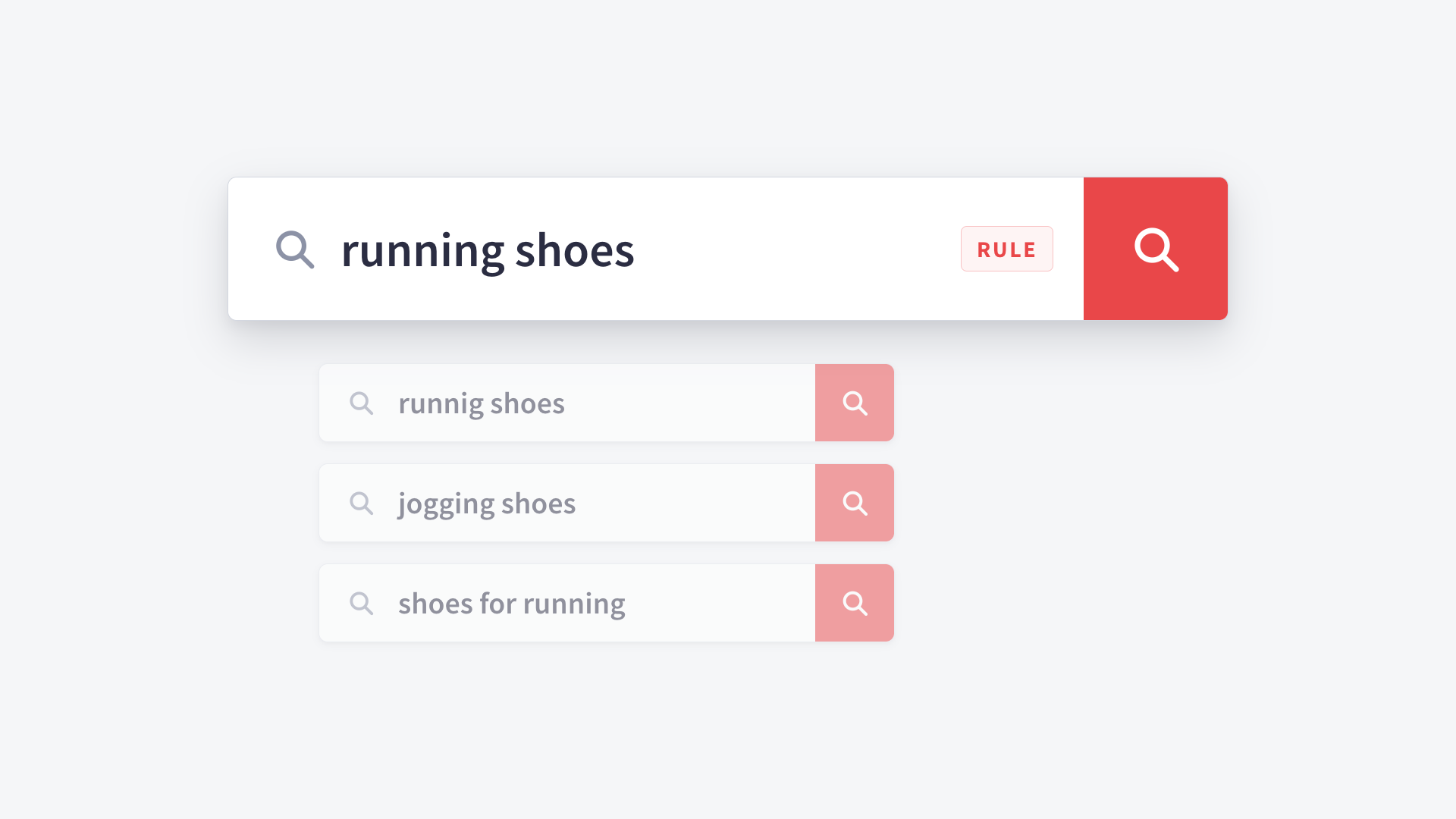
Take the shoppers who want running shoes. One types "running shoes", the next "runnig shoes", others "jogging shoes" or "shoes for running". To your engine each of those is a separate query. A rule on "running shoes" catches the first one and misses the typo, unless someone thought of it, and most of these variants turn up too rarely for anyone to notice. Even AI chatbots tend to miss them, or draw false correlations.
A rule or a synonym for every one of them would take forever (we repeatedly see thousands of long-tail terms for one customer intent), even with an assistant doing the typing. You would still be guessing at spellings that hardly come back, with no way to tell which version of the intent sells.
The E-Commerce Specialist at Fritz Berger, for example, put the scale of it in one line: "Even if I manually optimized 20% of the terms, I'd never match what searchHub delivers on its own."
Stop writing rules for variants
The way out is to stop treating each spelling as its own problem. Whatever the shopper types, "runnig shoes" and "shoes for running", it's clear they're after the same pair of shoes.
Removing the heavy processing load from your search engine and the related product catalogue improves the case for successful search and product discovery optimization by tackling this problem at the query before your engine sees it. To this end, you need to collect all variants that share one purchase intent and only then hand your engine the version of that query that sells the most product. On our site we say it like this: "Thousands of spellings collapse to one proven query. No synonym maintenance."
We test every change on your own traffic for identical intent, query against query. Changes that don't measurably improve results are rolled back.
In the engines I know, a rule only gets tested against another version at identical intent if a person sets that test up, in some kind of test system. Even in the instances where an engine reports how a rule performed, a person still has to read the report and act on it.
Taking a second to beat our own drum: the E-Commerce Manager Search at hagebau connect wrote in an OMR review: "Manual synonym maintenance was extremely time-consuming. searchHub now takes that over – clustering search terms and serving the one with the best conversion rate."
In the span of seven months, they optimized 2.5 million search terms, and the novomind iSHOP search engine underneath stayed as it was. You can read the full hagebau connect story on our site.
Where a hand-made rule still has its place
None of this makes rules useless. Some decisions belong to a person, and data should not overrule them.
Whatever you're legally obligated to show remains a manual rule, or the engine's assistant drafts it for you. A placement your brand or campaign team agreed on purpose stays one too, such as the landing page you built for Black Friday itself.
Drawing again from hagebau connect: they retained manual controls as well, while searchHub took over the synonym work related to them. A rule is good at holding a decision a person made, and an intent variant was never one of those.
What faster rule-writing changes
An assistant that drafts rules from plain language saves typing. The rule it writes still covers only the words someone thought of, and a person still has to approve it and decide when it ends.
The long tail stays out of reach of rules at any speed, because its queries are too rare and too varied to predict. A different optimization strategy is needed. An intelligent process, which manages grouping them by purchase intent and testing each rewrite against real purchase power, is what moves the needle at this level. This must be done on the engine you already use, today! You don't need a new search engine. No matter what anybody tells you.
To see which search journeys in your shop hold untapped potential, ask for the business case for your shop. Any online shop can ask, on whatever engine it runs, and the offer is open, with no end date. It is built from your real query data, not a sample, and you don't need a sales call to get it.
Keep your stack. Improve what it delivers.