This is Part 3 of “The Search Tax.” Part 1 described what’s structurally broken. Part 2 described who profits from keeping it broken. This part describes what it takes to fix it – not with promises, but with architecture.
The problem isn’t your search engine
Let’s start with something that might feel counterintuitive: your search engine probably works fine.
Algolia, Elasticsearch,FactFinder, Bloomreach, Solr – they all do what they’re designed to do. They take a query, match it against an index, and return results. The technology is fast, configurable, and mature.
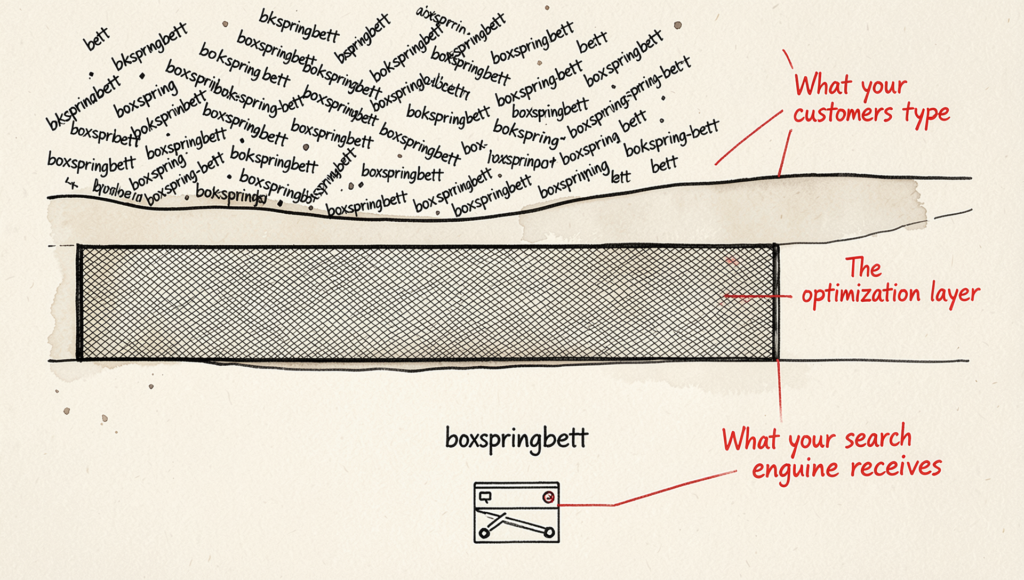
The problem is what happens before the query reaches the engine. The mess of misspellings, abbreviations, long-tail queries, ambiguous terms, and intent variants that your customers type into the search bar. Your search engine can only work with what it receives. And what it receives, in most cases, is chaos.
3,500 keyword variants for a single product category. 5,000 ways to spell “boxspringbett.” Queries that mean the same thing but look entirely different to a text-matching system. Your search engine processes each one of these as a separate lookup. And your team manually patches the gaps with synonyms, redirects, and rules – one at a time.
The search tax isn’t caused by bad search engines. It’s caused by the absence of an intelligence layer between your customers and your search engine. A layer that understands intent before the engine tries to match text.
What an optimization layer actually does
searchHub is that layer. It sits between your shoppers and your search engine – Algolia, Elasticsearch, FactFinder, whatever you run. It doesn’t replace your search. It doesn’t require a migration. It doesn’t touch your index, your ranking logic, or your infrastructure.
What it does is this: it tracks complete search journeys – every query, every click, every basket add, every purchase – without sampling. 100% of search behavior, captured through search trails rather than session-based tracking.
Why this matters: while the industry standard captures session data, searchHub sees all of it. The optimization decisions it makes aren’t based on a fraction of reality. They’re based on the complete picture.
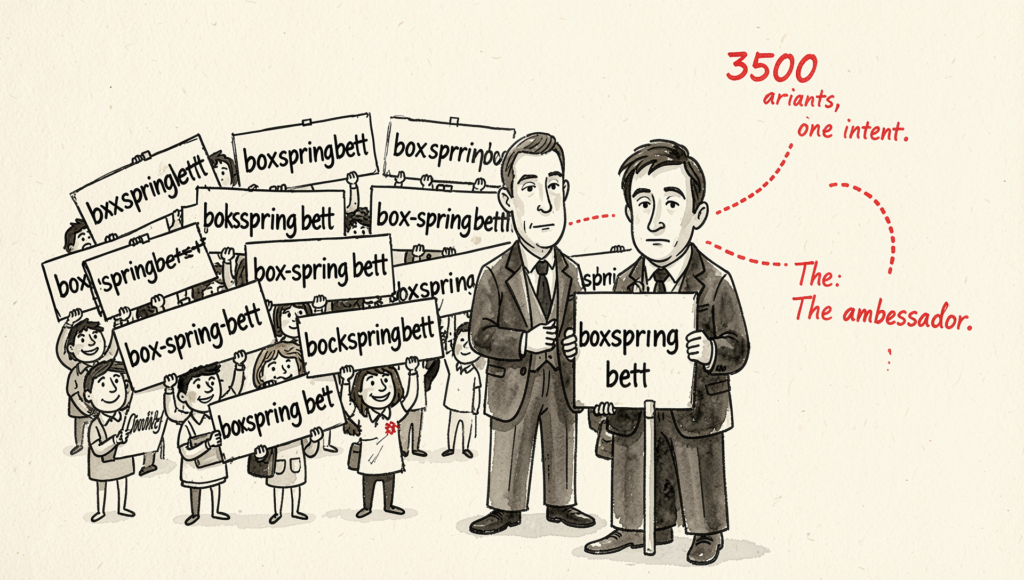
From that data, searchHub builds purchase intent clusters. It takes those thousands of query variants – the misspellings, the abbreviations, the long-tail improvisations – and groups them by what the customer actually intended to buy. Then it selects the highest-performing keyword from each cluster: the one with the best conversion data, the most clicks, the most basket adds. That keyword becomes the ambassador for the entire cluster.
When a customer types “bxsprngbett,” searchHub doesn’t pass that to your search engine. It passes “boxspringbett” – the query proven to produce the best results. Your search engine receives cleaner input. Your results improve. No synonyms written. No redirects configured. No human intervention required.
This is what it means to reduce the search tax at the architectural level: fewer junk queries hitting the engine, fewer manual rules compensating for what the engine can’t understand, and fewer zero-results pages caused by queries the system had never seen before.
smartSuggest: the suggest layer that earns its space
Part 1 of this series described the suggest layer as “the steering wheel nobody audits.” Here’s what it looks like when someone audits it and builds something better.
smartSuggest 2.5 transforms the autocomplete dropdown from a word-completion tool into an intent-driven discovery layer. It does four things that standard autocomplete cannot:
First, it separates query suggestions from product suggestions. Standard autocomplete shows you a list of query completions. smartSuggest shows you the queries most likely to convert and the specific products that match the emerging intent – before you finish typing. The customer goes from a vague idea to a concrete product evaluation in the suggest dropdown itself.
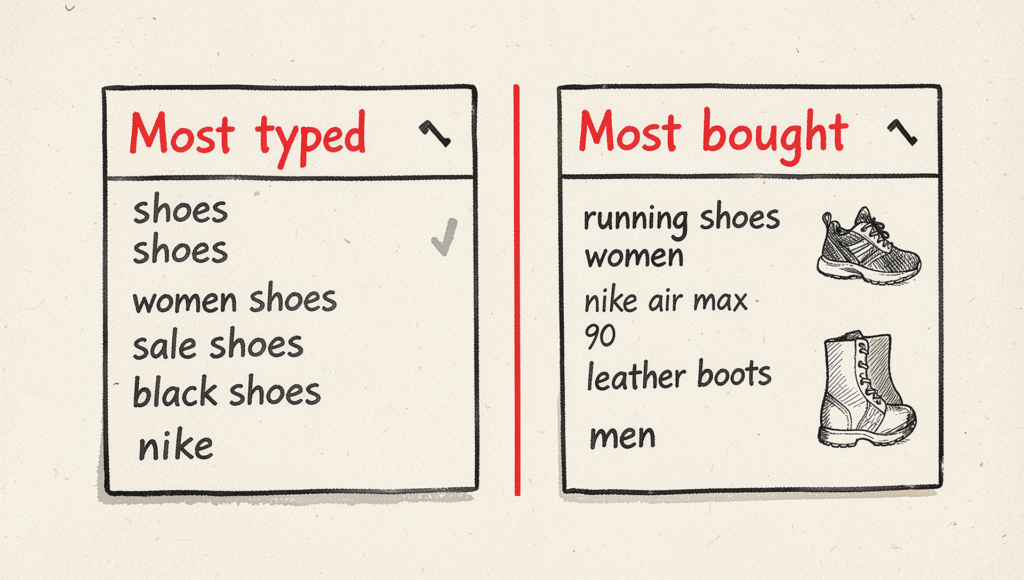
Second, it prioritizes by purchase intent, not query frequency. Standard autocomplete surfaces the most popular queries. smartSuggest surfaces the queries that lead to purchases. The difference is the same as the difference between “most discussed” and “most bought” – they’re rarely the same list.
Third, it handles ambiguity. When a query is broad or could mean several things, smartSuggest introduces category-level refinements. Type “box” on a furniture site, and instead of guessing, it offers “box spring beds,” “storage boxes,” “boxing gloves” as scoped suggestions – each leading to a filtered result set that makes sense.
Fourth, it starts working before the customer types. Pre-suggestions use page context, active campaigns, and browsing behavior to surface relevant starting points the moment the search bar gets focus. The customer’s journey begins guided, not blank.
Sonja, Onsite Search Manager at Fritz Berger, put it this way: “Every software provider advertises AI and promises magic. With searchHub it’s actually true.”
What makes it true isn’t the label. It’s the mechanism: purchase intent clusters built from complete search trails, surfaced as suggestions that lead to products and conversions – not keyword-frequency guesses that fill a dropdown without filling a cart.
The proof structure
Enough mechanism. Let’s talk results.
But let’s talk about them properly – problem, mechanism, result – because a number without context is just decoration.
Fritz Berger’s problem: 3,500 keyword variants for a single product category, managed manually. The mechanism: searchHub clustered those variants into purchase intent groups automatically, based on actual conversion data. The result: the manual synonym workload for that keyword dropped close to zero. The search manager’s time shifted from maintaining rules to analyzing customer behavior.
A retail brand’s problem: high search abandonment – customers typing queries, seeing poor suggestions, and leaving. The mechanism: smartSuggest replaced frequency-based autocomplete with intent-driven suggestions, surfacing proven queries and matching products before the search executed. The result: search abandonment dropped 62% in the first quarter.
Niclas, E-Commerce Project Manager at HELLWEG: “With searchHub I can make valid data-based decisions, bypassing the bullshit bingo of other vendors.”
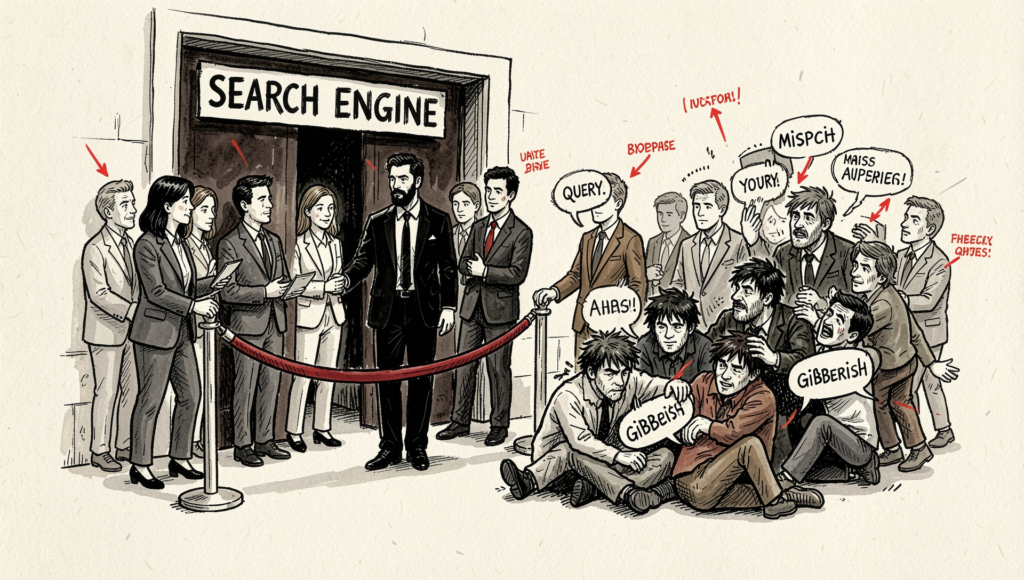
Rick, Product Owner at Decathlon Deutschland, called it “the bouncer for your shop’s internal search.” That framing is more accurate than most vendor positioning: searchHub filters the noise before it reaches your search engine, so your engine only processes queries worth processing.
These aren’t uplift percentages floating in space. They’re specific problems, solved by a specific mechanism, verified by people willing to attach their names and companies to the claim.
What it doesn’t do
Honesty means acknowledging limits.
searchHub is not a search engine. If your search engine is fundamentally misconfigured – bad ranking logic, wrong index structure, broken faceting – searchHub can’t fix that. It optimizes the input. It can’t compensate for a broken processor.
smartSuggest is not a standalone product. It requires searchHub’s data infrastructure – the clustering, the tracking, the intent mapping. Without that foundation, it’s just another suggest tool.
How to stop paying
The search tax is structural. You don’t eliminate it with better synonyms or smarter redirects. You eliminate it by changing the architecture – by putting an intelligence layer between your customers and your search engine that understands intent before the engine tries to match text.
searchHub is that layer. smartSuggest extends it into the suggest dropdown. Together, they reduce the volume of raw queries your engine has to process, eliminate the manual grind of synonym and rule management, and give your suggest layer something it’s never had: commercial intelligence.
No replatforming. No migration. No replacing what you’ve already built. It sits in front of your search engine and makes it work better.
A/B test it. Watch the numbers. If it works, you’ll see it in conversion data within weeks – real data, from your search traffic.
If it doesn’t work, you’ve lost nothing. Your search engine keeps running as before.
That’s not a sales pitch. That’s a risk profile.
Dirk, marketing manager at ROSSMANN, said it simply: “searchHub targets the gap where almost all search providers still fail today.”
The gap is real. The tax is real. The question is how long you keep paying it.